
Household history
What Was Grandma’s Pantry? The 1955 Civil Defense Program, From the Original Documents
Last updated
Grandma’s Pantry was a campaign of the Federal Civil Defense Administration, started in the spring of 1955, that asked every American family to keep a seven-day supply of food and water at home. It borrowed the picture of a grandmother whose shelves were always full, and it reached families through grocers, Sears stores, county fairs and two leaflets.
Each fact below carries its source and, where the source has one, its page.
What the agency wrote down
The FCDA’s Annual Report for 1955, its fifth, records the campaign on page 82:
“To bring attention to FCDA’s recommendation that every family maintain a 7-day supply of food and water for an emergency, a Grandma’s Pantry promotion was started in the spring. The Grandma’s Pantry idea (“Grandma was always ready for an emergency”) originated in New York and was expanded in Maine.”
The Administrator’s own review, on page 8, is plainer: “The Grandma’s Pantry exhibit appealed to women everywhere.”
| What | The record | Where |
|---|---|---|
| The supply each family should keep | 7 days of food and water | Annual Report 1955, pp. 8 and 82 |
| Exhibits the FCDA produced | 1,000, “for use in stores and at fairs, conventions, and other meetings” | p. 82 |
| Exhibits Sears, Roebuck took | 500, “more than half” | pp. 8 and 82 |
| People who saw FCDA exhibits that year | More than 3 million, across all its exhibits, not only the pantry | p. 8 |
The supply was seven days. The report says so twice, and the 1956 leaflet asks for “a 7-day food supply” in its own words.
Where the idea came from
The report credits New York with the idea and Maine with growing it. Jean Wood Fuller, who ran the FCDA’s programs for women, told the rest in a 1976 oral history. A friend in Maine, Inez Wing, was active in civil defense there, and one of her local groups had developed the idea. Fuller asked if she might spread it. In her own word, she “appropriated” it.
Her office drew the artwork. The National Grocers’ Association gave the campaign free space in its trade journals. Sears built window displays from an FCDA mock-up that featured a camp stove. Women’s civil defense volunteers handed the leaflet out from booths at fairs. Fuller thought it probably had the widest coverage of anything her office did.
The 1955 leaflet
The campaign’s leaflet came out in 1955 under a title that asked a question: Grandma’s Pantry Was Ready: Is Your “Pantry” Ready in Event of Emergency? Its Superintendent of Documents number is FCD 1.2:P 19.
Its opening line, as Fuller read it aloud from her own copy and as historians quote it:
“Grandma’s Pantry was always ready. She was ready when the preacher came on Sunday or she was ready when ten relatives arrived from Nebraska.”
With the leaflet in her hands, Fuller gave its instruction: “Check your pantry at least once a month and rotate it regularly.” The legible words of its supply list, in the copy reproduced in her transcript, include crackers, shortening, safety matches and candles.
The 1956 leaflet
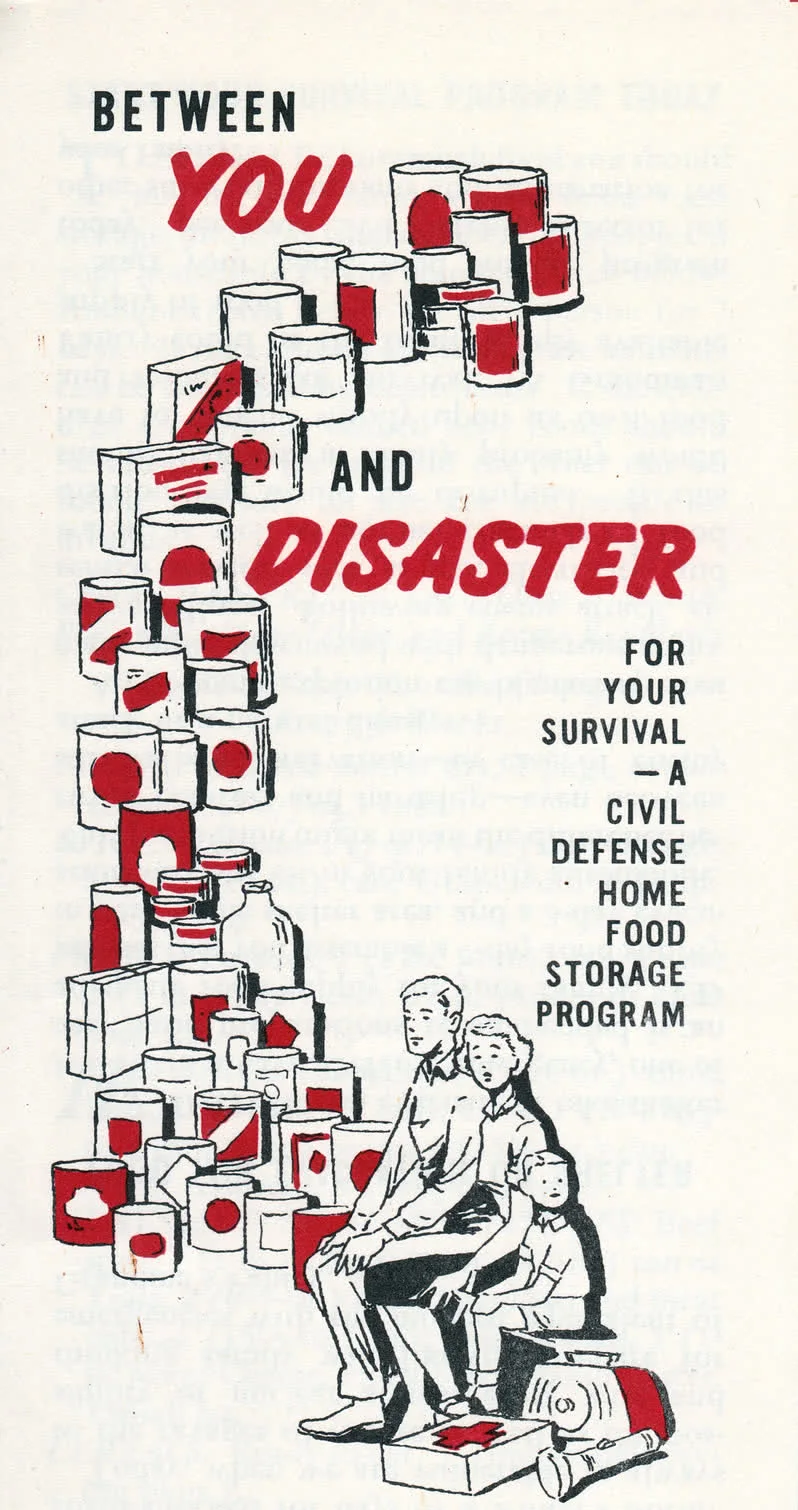
A year later the FCDA issued leaflet L-1, Between You and Disaster, a home food storage program. It opens under the same headline, “Grandma’s Pantry Was Ready,” and asks:
“Remember Grandma’s Pantry, its shelves loaded with food, ready for any emergency, whether it be unexpected company or roads blocked for days by a winter’s storm?”
It asks each family for “a 7-day food supply in your home shelter area, and a 3-day evacuation-survival kit in your family automobile.” It prints the rotation rule in italics: “Check ‘PANTRY’ at Least Once a Month, Preferably More Often, and Rotate Regularly.” It also asks that bottled water be changed every six weeks.
What it looked like on the ground
In Lexington, Kentucky, 500 women from across the state came to a women’s civil defense conference, and “the city park department constructed a complete Grandma’s Pantry” in the auditorium foyer. It had stocked shelves, an old-fashioned stove and a hand pump. “A grandma occupied a rocking chair in the pantry exhibit and answered questions about civil defense planning” (Annual Report 1955, pp. 173 to 174).
In Lincoln, Nebraska, women “enlisted all grocers and wholesalers in a citywide Operation Can Opener, similar in nature to the Grandma’s Pantry project.” The American Home ran an article on the idea, titled Grandma’s Pantry, New Style, in its September 1955 issue (Annual Report 1955, p. 82 and the regional section).
The pantry that went to a test site
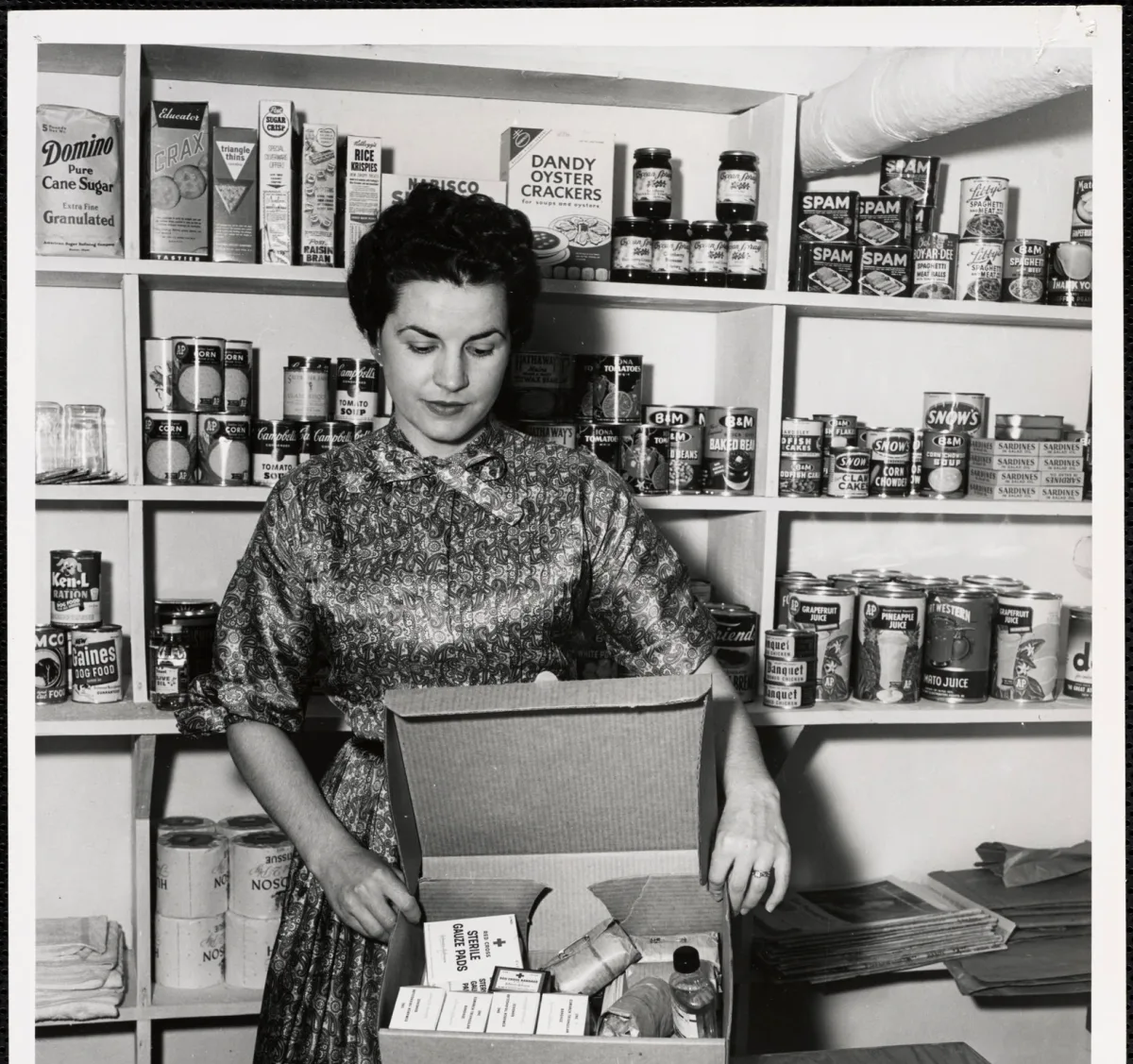
In May 1955 the FCDA ran Operation Cue at the Nevada Test Site, to see how ordinary houses and their contents would stand up to an atomic test. Two Grandma’s Pantry exhibits went into test houses, stocked by the National Canners Association with about 300 cans of about 30 different foods.
The association’s Information Letter of 14 May 1955 reported that the pantry stored under the basement stairs of a frame house “came through very well,” and that the second, in a cupboard in a one-story house, “was in good condition.”
One detail does not match the campaign. The test pantry was sized “to care for a family over a three-day emergency period.” The FCDA’s published recommendation that same spring was seven days.
What became of it
The National Canners Association’s Information Letter of 4 November 1961 carried a speech its president, John C. Hemingway, gave to the Florida Vegetable Canners Association in Miami Beach. “Let us not merchandise alarm or panic,” he told them. “Many of us remember ‘Grandma’s Pantry.’ Maybe we should go back to her calm and provident tactics.”
Civil defense later passed to a new federal agency. Executive Order 12127 established the Federal Emergency Management Agency, effective 1 April 1979, and Executive Order 12148, signed on 20 July 1979, gave it “the dual mission of emergency management and civil defense.”
What the record cannot confirm
- The 1955 leaflet’s full text. No public-domain scan of FCD 1.2:P 19 has turned up online. Its opening line is known from Fuller’s 1976 reading and from Elaine Tyler May’s Homeward Bound (1988), which quotes the brochure.
- ”Unexpected company.” The phrase is the FCDA’s own, from the 1956 leaflet, and a civil defense radio spot, “Take the Step: Grandma’s Pantry,” uses it too. It is not in the 1955 leaflet’s opening as Fuller read it.
- The radio spot’s date. The transcript’s host dates it to 1953, before the national campaign began. That date could not be confirmed.
- The American Home article. It is known from the FCDA’s report. The article itself has not been read.
The 1955 standard against today’s
Ready.gov, the federal preparedness site today, asks households to keep food, water and supplies to last for “several days,” with one gallon of water per person per day. The 1955 standard asked for a week.
Not every 1955 tip has held up. In 1976 Fuller suggested refilling an empty chlorine-bleach bottle with water, and current guidance at Ready.gov calls for food-grade containers only. Where a period document and a current official page disagree, follow the current page.
Sources
- Federal Civil Defense Administration. Annual Report for 1955 (fifth annual report). Pages 8, 82, 173 to 174 and the regional sections. archive.org/details/fcda1955annualreportfor1955
- Federal Civil Defense Administration. Grandma’s Pantry Was Ready: Is Your “Pantry” Ready in Event of Emergency? 1955. SuDoc FCD 1.2:P 19. Listed in American Library Association GODORT, “Exhibits: Disasters and Emergencies.”
- Fuller, Jean Wood. Organizing Women: Careers in Volunteer Politics and Government Administration. Oral history recorded 1976, Regional Oral History Office, The Bancroft Library, University of California, Berkeley. Pages 187 to 188 and 187a. archive.org/details/orgwomenvolpolgo00fullrich
- Federal Civil Defense Administration. Between You and Disaster. Leaflet L-1, 1956. Panels 2 and 3. archive.org/details/martindmcginn_gmail_2
- National Canners Association. Information Letter No. 1536, 14 May 1955 (Operation Cue). Internet Archive.
- National Canners Association. Information Letter No. 1851, 4 November 1961 (Hemingway speech to the Florida Vegetable Canners Association). Internet Archive.
- “Take the Step: Grandma’s Pantry.” Civil defense radio spot. Transcript at The Authentic History Center.
- May, Elaine Tyler. Homeward Bound: American Families in the Cold War Era. 1988.
- Federal Emergency Management Agency. “History of FEMA.” fema.gov/about/history
- Ready.gov. “Build A Kit” and “Water.” ready.gov/kit and ready.gov/water
Web sources were read on 6 November 2026.